 DentalClinics
How it works
Your radiograph goes to the AI platforms you subscribe to. Each reading comes back attributed to its source, differences are flagged rather than resolved, and you decide. Nothing is written to disk at any point.
What you see
Your radiograph goes to the platforms you subscribe to
One bitewing or panoramic image, sent over HTTPS through our API to each AI platform connected for your practice. You keep your own subscription with each vendor.
Each finding comes back attributed
Platform, version, tooth and surface, placed on one odontogram. For every finding you can see which platform reported it.
Differences are flagged, not resolved
Where only one platform reports a finding, you see that. Where a platform reports a finding on a tooth your chart records as missing, it is flagged for review. No averaging, no consensus, no score.
You decide
The tool does not say which platform is right. It shows who reported what, so your clinical examination starts from the full picture. The clinical reading remains yours.
Today. The readings shown in our demonstration come from three mock platforms on a synthetic case. No vendor platform is bundled with us yet: your own platforms are connected when your practice starts, and the comparison then runs on your de-identified radiographs.
What happens to the image
Your practice sends a radiograph
Over HTTPS, through our API. Intraoral and panoramic images are accepted as DICOM or as standard image formats.
We route it to the platforms you selected
The image is held in process memory for the duration of the request and forwarded to each vendor you chose. We do not train models, we do not build a dataset, and we do not read the image for any purpose other than routing it.
The readings come back to you
Each vendor's findings are returned in the same exchange, attributed and placed side by side. The clinical reading remains the practitioner's.
Nothing remains
The buffer is released when the request closes. Retention period: zero seconds after the result is returned. This is a property of the architecture, not a policy we promise to follow.

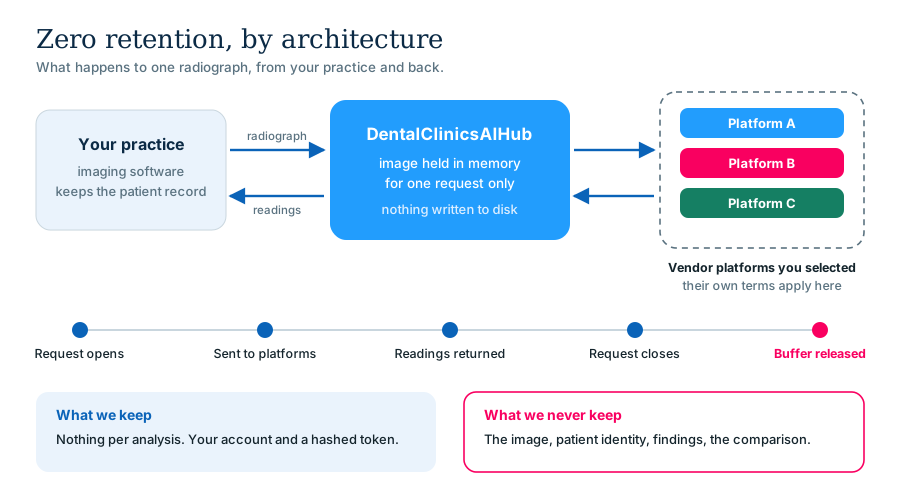
What we keep. Nothing per analysis: only your practice account and the hash of its access token. Billing is per location and per month, so no analysis is ever counted.
What your vendor keeps. That is between you and them, and it is governed by their own terms. We say what we do; we do not speak for them.
What this means for a due diligence questionnaire
Most questions about encryption at rest, backup retention and data deletion procedures do not apply here, because there is nothing at rest. That answer is unusual enough that we put it in writing in the data processing agreement rather than leave it as a marketing line.
See it for yourself in 30 minutes
From US$ 390 per month per locationAI vendor subscriptions billed separately
DentalClinicsAIHub is an integration and access platform. Regulatory status belongs to each vendor for its own product.